
 Business License
Blog Categories

What Is a MAPP Gas Torch? Definition and Core Components
A technician new to refrigeration work once asked why a 22 mm brazed joint that took 20 minutes with a propane torch came together in about 6 minutes with the same style of torch on a different cylinder. The difference was not in the torch body at all. It was in the fuel inside the cylinder and in the way the burner had been shaped to burn it.
A mapp gas torch definition therefore starts with the gas rather than with the hardware. MAPP is a stabilised blend of methylacetylene and propadiene, and it releases heat faster than propane through a burner of the same size.
This article sets out what the definition covers, lists the mapp torch core components from cylinder to tip, and explains how gas torch burner design decides flame shape and where the heat lands. It closes with two workshop cases and the questions buyers send most often.
1. What the MAPP Gas Torch Definition Covers
A mapp gas torch definition describes a hand-held torch that burns MAPP or a stabilised equivalent, delivering a single flame from a small cylinder without a separate oxygen supply.
The self-contained part matters. Because the torch draws air from the surrounding atmosphere rather than from a second cylinder, it can be carried up a ladder, into a ceiling void or onto a roof without a hose set.
The definition also covers a working range rather than a single point. A typical hand torch on a 400 g cylinder holds a flame long enough to braze small copper fittings and to soften seized fasteners, and it stays portable enough to keep in a service bag.
Yichun Wentu Imp&Exp Trade Department describes this class of torch as an air-fuel hand torch, which separates it from oxygen-fed welding sets that reach much higher temperatures but need two cylinders and a trained operator.
2. MAPP Torch Core Components From Handle to Tip
The mapp torch core components form a short chain, and every link in that chain sets a limit on the flame at the end of it.
| Component | Function | Typical detail |
|---|---|---|
| Cylinder | Stores the fuel under pressure | 400 g disposable, or 1 kg and larger refillable |
| Regulator or valve | Sets working pressure at the handle | Fixed on hand torches, adjustable on hose sets |
| Hose | Carries gas to a remote handle | 5 mm bore for single tip, 6 mm for wider heads |
| Handle and valve body | Controls flow and holds the head | Brass body with a needle valve |
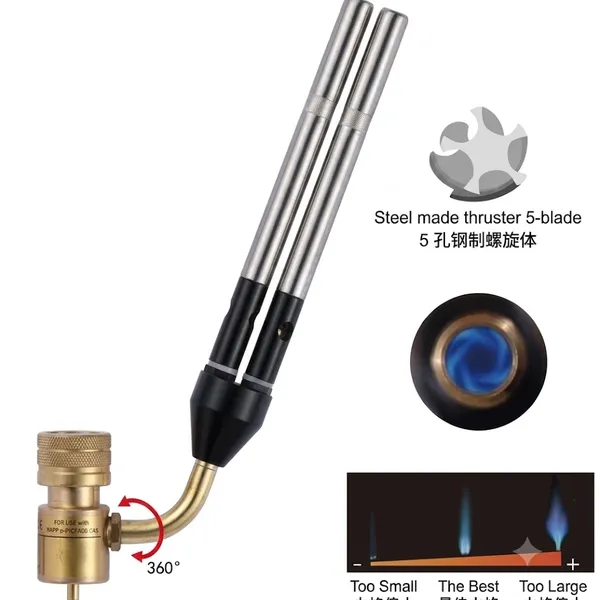
| Burner tip | Mixes gas with air and shapes the flame | Single, dual or triple tip, 10 mm to 100 mm heated band |
| Ignition | Lights the mixture at the tip | Piezo trigger or an external lighter |
The chain has one governing rule: the narrowest aperture in the path sets the maximum flow. A 6 mm hose behind a small single tip gains nothing, and a small hose behind a wide head starves the flame at full setting.
Brass is the usual material for the valve body because it machines cleanly, resists the heat that conducts back from the tip, and holds a thread through repeated head changes.
Wintooltech assembles these parts as matched sets, so that the tip, the valve and the cylinder connection are chosen together rather than bought separately and hoped to work.
3. Gas Torch Burner Design and Flame Shape
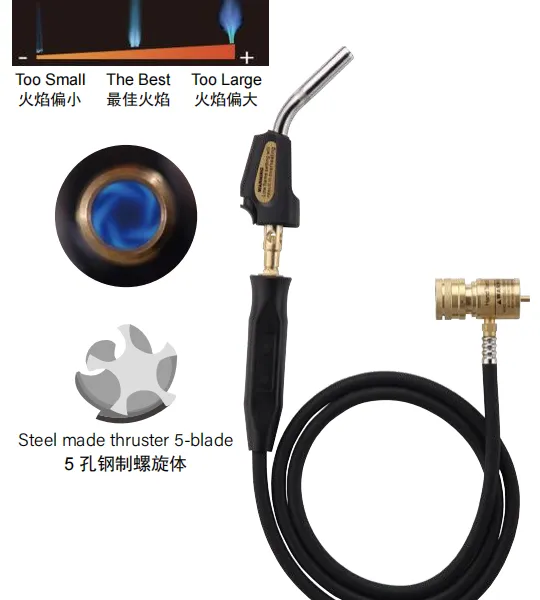
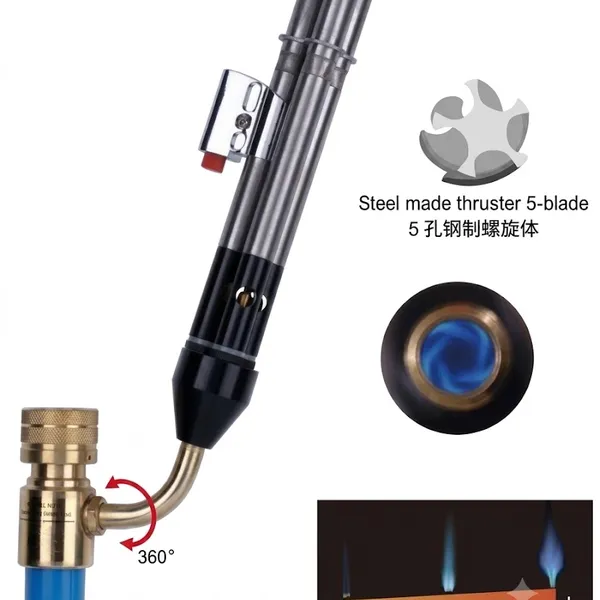
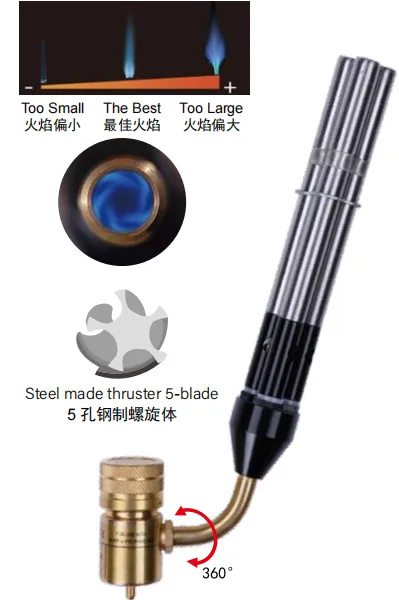
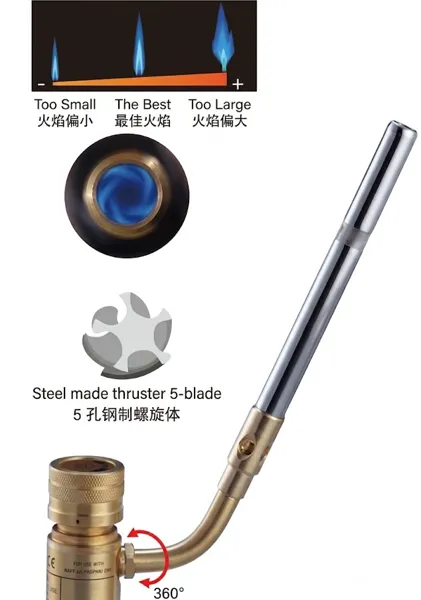
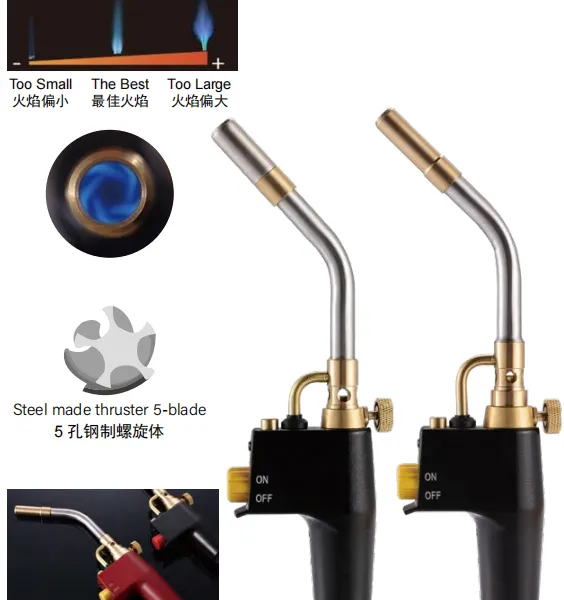
Gas torch burner design decides how the flame behaves, and the mechanism is more interesting than the outside of a tip suggests. Air enters through ports near the base, mixes with gas in a venturi, and the mixture burns at the face of the tip.
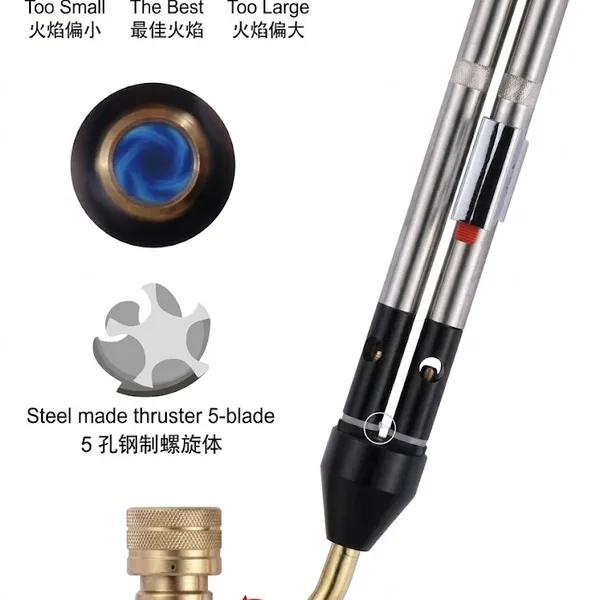
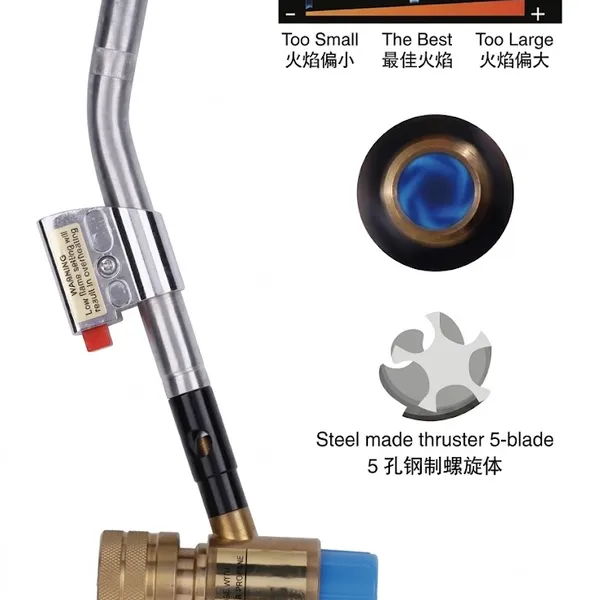
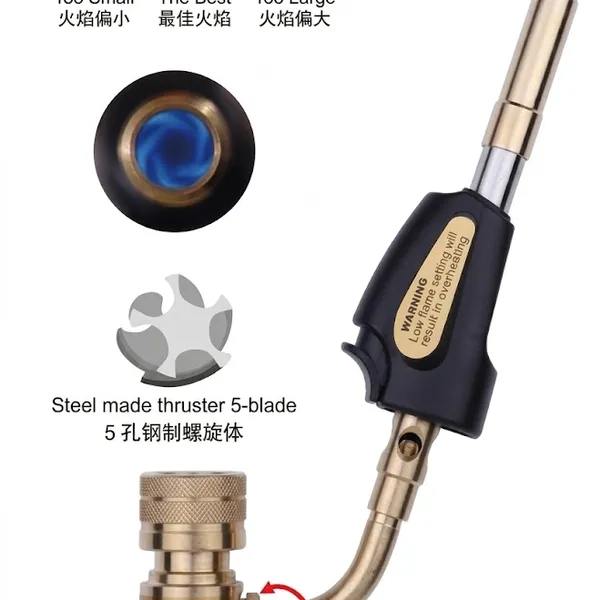
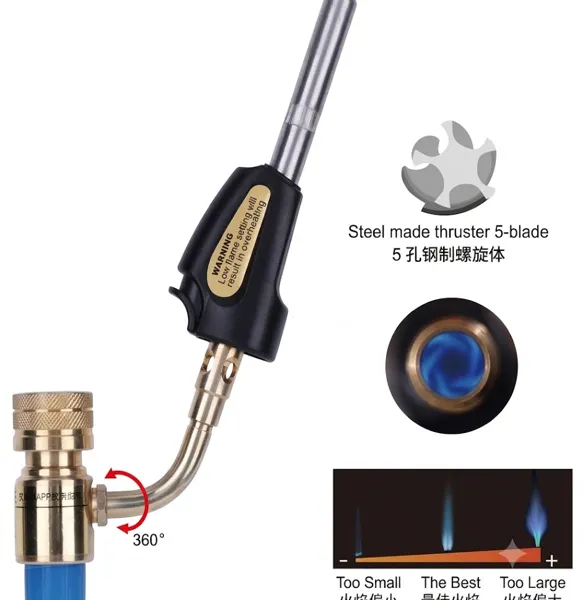
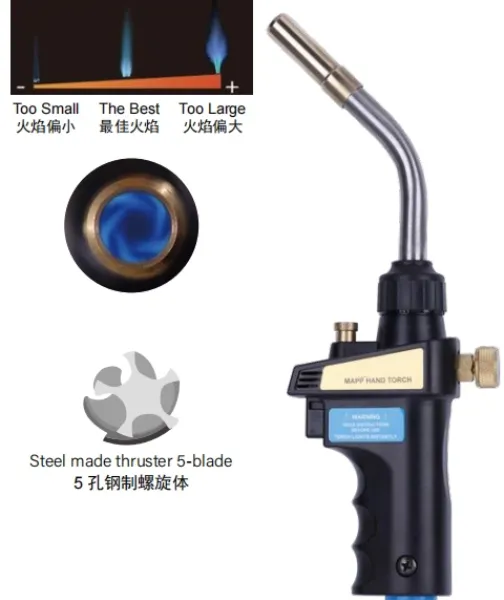
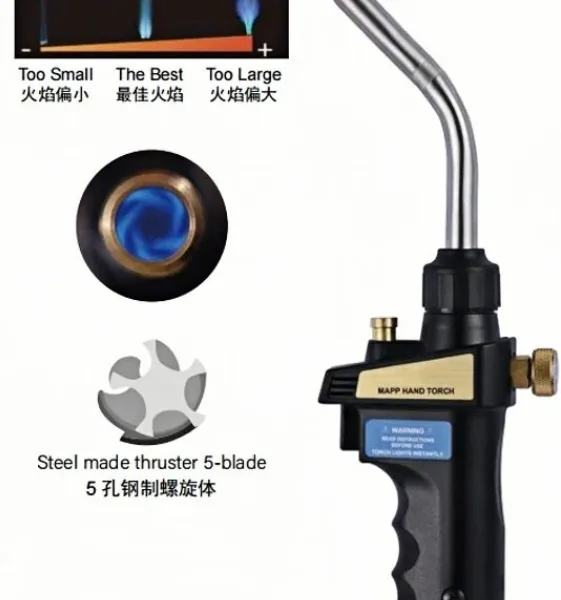
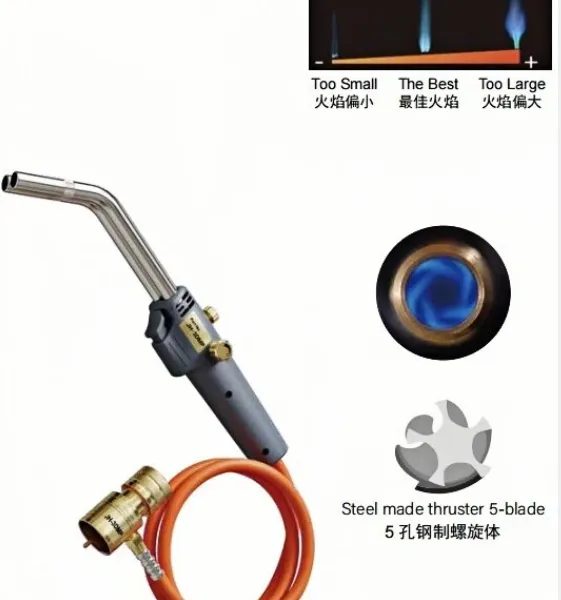
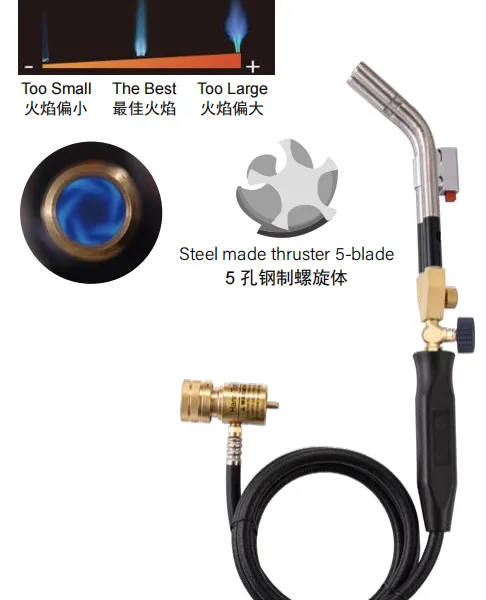
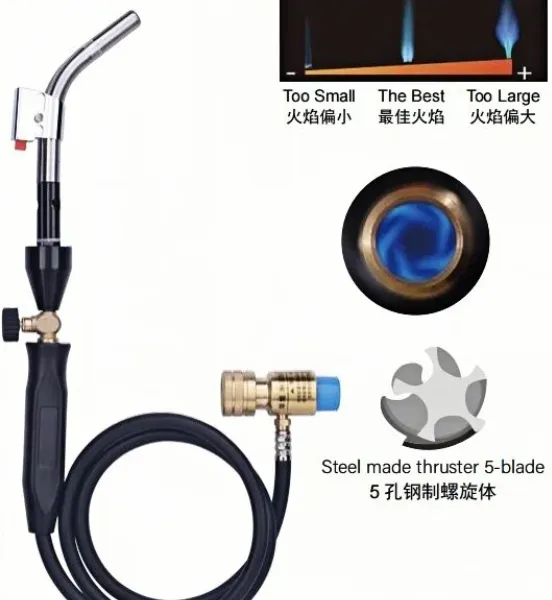
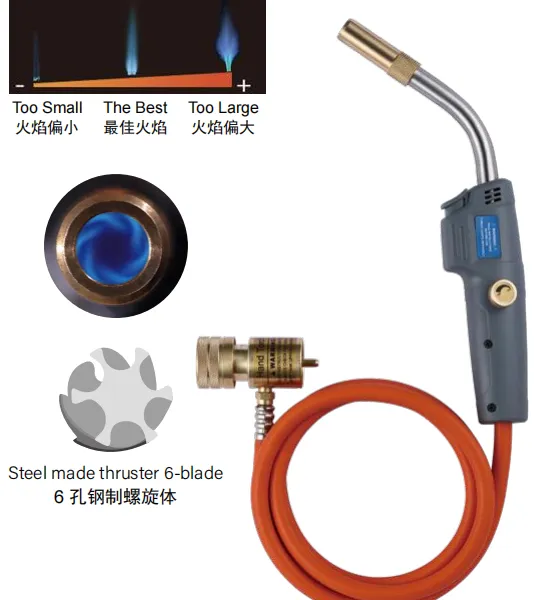
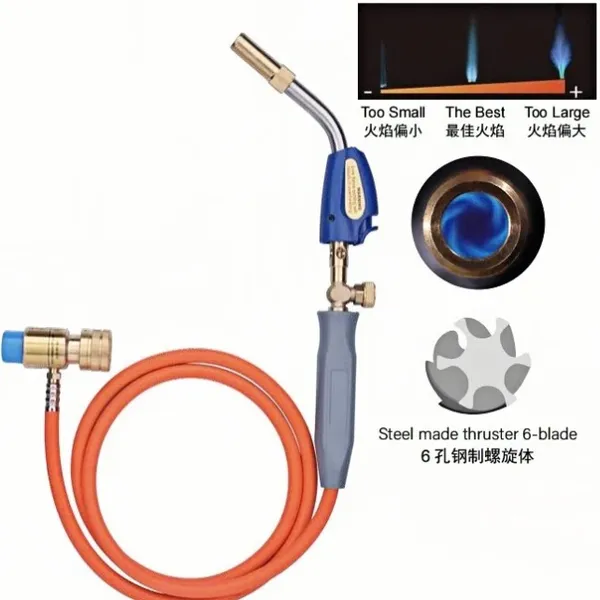
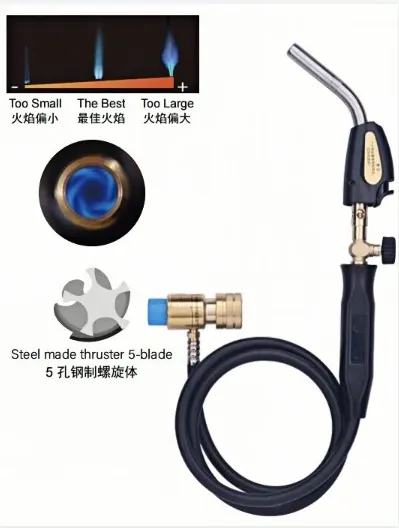
A common approach uses a swirl pattern, where the gas-air mixture is given a rotational path before it leaves the tip. Swirl holds the flame steady at low flow, which is what keeps a small tip lit when the operator turns the valve down to work near a heat-sensitive part.
Tip diameter then sets the flame area. A 10 mm tip concentrates heat into a spot small enough for a 6 mm tube, while a 25 mm tip spreads the same mixture over a wider face for larger fittings.
The other design choice is port count, which is what separates a single tip from a dual or triple head. Adding tips increases the heated band without raising the peak flame temperature, so a wide head heats more metal to the same temperature.
Wentu treats port geometry as a maintenance question rather than a fixed property, since a tip cleaned with the wrong tool loses the shape its ports were cut to. A tip that has been reamed with a wire brush will hold a flame at full flow and lose it at low flow, which is the setting most service work depends on.
4. Why MAPP Gas Differs From Propane in a MAPP Torch
Users who move from propane to MAPP usually notice speed before they notice temperature, and the numbers explain why. MAPP burns at roughly 2,020 °C in air against about 1,980 °C for propane, a difference of about 2 percent.
The useful gap sits in heat release. MAPP holds more energy in each unit of gas burnt, so a joint reaches working temperature sooner even though the peak flame temperature has moved slightly.
Cylinder behaviour differs as well. Propane loses pressure quickly as the cylinder cools and empties, which shortens the flame late in a cylinder's life, while MAPP holds a more even working pressure across the same span.
Availability has shifted in some markets, where a propylene-based blend is sold in place of MAPP under a different trade name. The torch hardware is the same, and a mapp gas torch definition written around a specific trade name dates quickly as a result.
5. Cylinder, Regulator and Hose in MAPP Torch Core Components
The gas supply side of the mapp torch core components deserves more attention than it usually gets, because a partial blockage there shows up as a weak flame at the tip.
| Setup | Cylinder | Typical work |
|---|---|---|
| Hand torch, cylinder mounted | 400 g disposable | Service calls, small fittings, short brazing jobs |
| Hand torch, larger cylinder | 1 kg to 2 kg refillable | Workshop benches, repeated joints through a shift |
| Hose torch with regulator | Refillable, standing upright | Bench work, long sessions, wider heads |
A hose torch moves the cylinder off the handle, which cuts the weight a technician holds and lets a larger cylinder stay upright on the ground. That arrangement suits bench work where a joint runs for several minutes.
Hose length is a compromise. Longer hose keeps the cylinder clear of the work, while every metre adds a small pressure drop, so 1.5 m to 3 m covers most bench and service layouts without noticeable loss.
Yichun Wentu supplies hoses and regulators matched to the head range, because a regulator tuned for a single tip does not always hold pressure behind a triple head at full flow.
6. Ignition Systems and Gas Torch Burner Design
Ignition is the point where gas torch burner design either earns trust or loses it, since a torch that lights unreliably is set aside in favour of one that lights on the first press.
Piezo ignition is the common arrangement, using a spring-loaded crystal to generate a spark at the tip. It removes the need for a separate lighter and keeps one hand free, which matters when the other hand is holding a tube in position.
Self-igniting tips take the idea further by placing the electrode inside the burner face. This improves reliability in wind, where a spark generated outside the tip can be blown away from the gas.
The service consideration is that ignition parts wear. Electrode gap widens with use, and a torch that needs two or three presses on a cold morning is usually due for an electrode adjustment rather than a new torch.
Wind is the condition that exposes the difference between the two arrangements. A spark generated outside the tip can be pushed away from the gas before it lights, and a technician working on a rooftop notices this on the first attempt of the day. An electrode positioned inside the burner face keeps the spark within the gas path, which is why self-igniting tips appear on torches sold into outdoor trades. The cost sits in the tip assembly, which is replaced as a unit when the electrode wears rather than being repaired on site.
7. Safety Features Built Into a Gas Torch Burner Design
Safety in a gas torch burner design comes down to three functions: stopping reverse flow, stopping flashback, and keeping the flame attached to the tip.
Reverse flow happens when pressure inside the tip drops below the pressure in the hose. A check valve in the handle prevents gas from travelling back down the line where it could collect and ignite at a connection.
Flashback is the harder case, where the flame travels back through the mixture path. A flashback arrestor or a sintered element in the body stops the flame before it reaches the hose, and this part belongs in any hose-torch assembly.
Flame retention is the third function and it is a design matter rather than an accessory. A tip with correctly sized ports holds the flame at the face across the working flow range, while a worn or oversized tip lets the flame lift away from the burner.
8. Two MAPP Gas Torch Definition Cases From the Workshop
Two workshops put the same definition to different uses and reached different conclusions about which parts matter. The first was a refrigeration service team brazing copper line sets from 12 mm to 28 mm on rooftops and in plant rooms.
Their kit had used propane for years, and a 22 mm brazed joint typically took about 20 minutes including a sweep on each side of the fitting. On a cold roof in winter the propane cylinder lost pressure and the flame shortened before the joint reached temperature.
Moving to MAPP on the same handle, with a dual tip in place of the single tip, cut that joint to roughly 6 minutes and removed the pressure fade. Consumption per hour rose by about half, while consumption per finished joint fell, and the crew finished four joints in a visit rather than two.
The second case was a jewellery repair bench working on silver fittings under 8 mm. That workshop kept a small single tip on a 400 g cylinder, because a wide flame would have damaged adjacent settings and used far more gas than the task required.
9. Frequently Asked Questions About a MAPP Gas Torch Definition
9.1 Is a mapp gas torch definition the same as a propane torch definition?
A mapp gas torch definition is close to a propane torch definition in hardware terms, since both burn a fuel gas in air from a single cylinder and both use a similar handle and tip. The differences sit in the gas and in the working pressure: MAPP reaches about 2,020 °C in air against roughly 1,980 °C for propane, releases heat faster per unit of gas, and holds a steadier pressure as the cylinder empties. The hardware is often shared, and some handles accept both fuels on the same thread.
9.2 What are the main mapp torch core components?
The mapp torch core components are the cylinder, the regulator or fixed valve, the hose where a remote handle is used, the handle and valve body, the burner tip, and the ignition mechanism. Each part sets a limit on the flame: the cylinder decides how long a session runs, the valve sets working pressure, the hose bore caps maximum flow, and the tip decides flame shape and heated area. Buyers who treat the set as a matched assembly avoid the common fault of a wide head starved by a narrow hose.
9.3 How does gas torch burner design affect flame stability?
Gas torch burner design affects stability mainly through air induction and port geometry. Air enters near the base, mixes with gas in a venturi, and burns at the tip face. A swirl pattern holds the flame attached at low flow, which keeps a small tip lit when the valve is turned down, while correctly sized ports keep the flame seated across the working range. A flame that will not stay lit usually points to a worn tip or an ignition electrode rather than to the gas.
9.4 Which torch head suits brazing copper fittings?
Head choice follows fitting diameter rather than gas choice. Fittings up to about 15 mm work with a single tip, mid-size fittings from 18 mm to 28 mm suit a dual tip because brazing needs the whole joint at temperature at once, and larger assemblies above 28 mm suit a triple tip or a hose torch with an adjustable regulator. Yichun Wentu supplies the three head types on one handle thread so that a workshop can change working width without buying a second torch body.
Recently Posted
-
Gas Torches in Jewelry Making and Precision Metalwork
October 16, 2026A repair bench once lost a ring setting to a flame that was too large rather than too hot. The torch was a workshop unit meant fo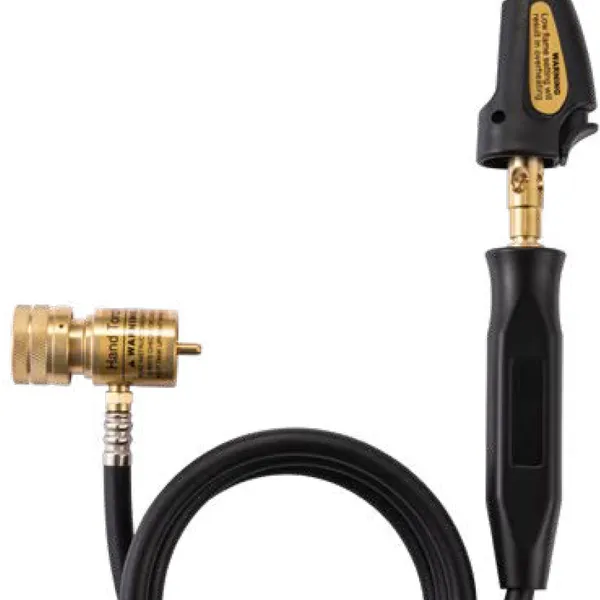 Read More
 -
Flame Temperature and Gas Pressure Specifications for Torches
October 16, 2026Two torches with the same headline flame temperature can behave quite differently on the bench, because the second figure on the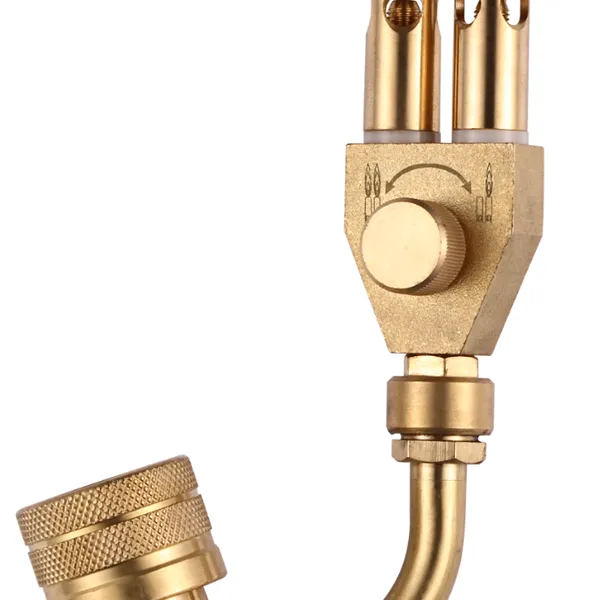 Read More
 -
Self Igniting vs Manual Ignition Gas Torches
October 16, 2026A technician on a roof replaced a torch mid job and noticed that the two models weighed the same and lit the same flame, yet one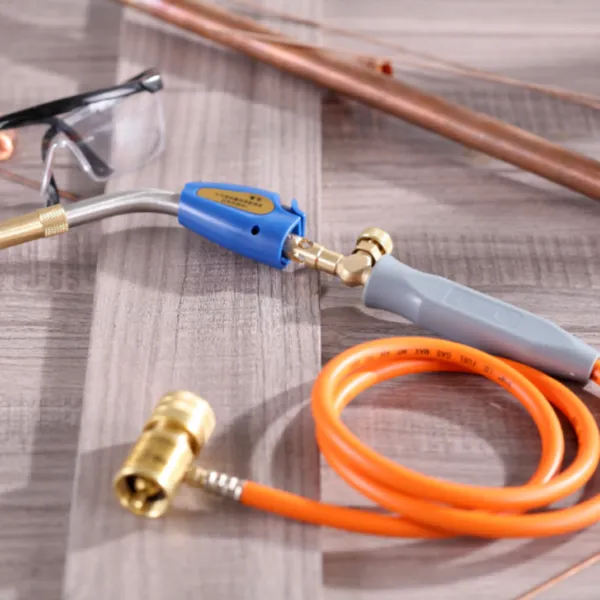 Read More
 -
Introduction to Air Fuel Torches: MAPP, Propane and LPG
October 15, 2026A workshop bought a torch for brazing refrigeration lines and found the flame too soft to bring a joint up to temperature. The to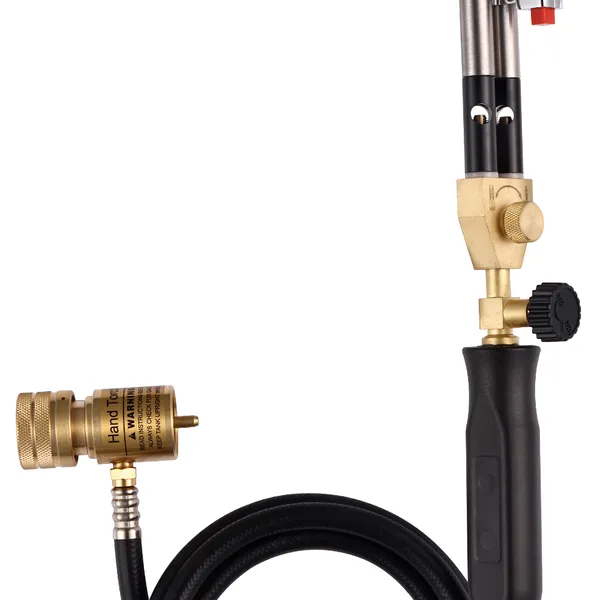 Read More

Contact Us
Recommended Products
-
 WT‑SSA Premium Aluminum Housing Self‑Igniting MAPP Torch, 360° Swivel Stainless Tip TorchNegotiableMOQ: 100 Pieces
 -
WT‑SST Self‑Igniting Brass Tip MAPP Torch, 360° Swivel Fast‑Cooling Premium Brazing TorchNegotiableMOQ: 100 Pieces
-
WT‑SS Self‑Igniting MAPP Gas Torch, 360° Swivel Stainless Steel Tip High‑Heat Brazing BlowtorchNegotiableMOQ: 100 Pieces
-
WT‑S 360° Swivel Single‑Tip MAPP/Propane Gas Torch, Stainless Steel Tip Manual Ignition Brazing TorchNegotiableMOQ: 100 Pieces
-
WT‑5STA Premium Aluminum‑Handle Pistol‑Grip MAPP Torch Heavy‑Duty Brass‑Tip Welding TorchNegotiableMOQ: 100 Pieces
-
WT‑5ST Pistol‑Grip MAPP Gas Torch With Fast‑Cooling Brass Tip Safety‑Lock TorchNegotiableMOQ: 100 Pieces
-
WT‑5S Ergonomic Pistol‑Grip MAPP Gas Torch Instant‑Ignition Safety‑Lock Brazing TorchNegotiableMOQ: 100 Pieces
-
WH‑DSVP Patented Switchable Dual‑Tip MAPP Hose Torch One‑Hand Needle‑Valve TorchNegotiableMOQ: 100 Pieces
-
WH‑SSVNP Patented Flexible Stainless Tube MAPP Hose Torch All‑Directional Gooseneck TorchNegotiableMOQ: 100 Pieces
-
WH‑DSVAP Patented Switchable Dual‑Tip MAPP Hose Torch Needle‑Valve & Aluminum‑Body TorchNegotiableMOQ: 100 Pieces
-
WH‑DSVA Dual‑Tip MAPP Hose Torch With Needle Valve Self‑Igniting Aluminum Igniter TorchNegotiableMOQ: 100 Pieces
-
WH‑SSVTP Patented One‑Piece MAPP Hose Torch One‑Hand Needle‑Valve & Thick Brass TipNegotiableMOQ: 100 Pieces
-
WH‑SSVT Deluxe MAPP Hose Torch With Needle‑Valve & Thick Brass Tip 6‑Blade Thruster TorchNegotiableMOQ: 100 Pieces
-
WH‑SSV MAPP Hose Torch With Needle‑Valve Flame Adjustment Self‑Igniting Extension TorchNegotiableMOQ: 100 Pieces
-
WH‑SST Self‑Igniting Brass Tip MAPP Hose Torch Fast‑Cooling Extension Brazing TorchNegotiableMOQ: 100 Pieces
-
WH‑SS Self‑Igniting MAPP Gas Hose Torch Flexible High‑Pressure Extension Soldering TorchNegotiableMOQ: 100 Pieces
-
WT‑TSA Self‑Igniting Triple‑Tip MAPP Gas Torch Aluminum Housing High‑Heat Brazing TorchNegotiableMOQ: 100 Pieces
-
WT‑T Triple‑Tip Ultra High‑Output MAPP Gas Torch 360° Swivel Three‑Flame Brazing TorchNegotiableMOQ: 100 Pieces
-
WT‑D1SA Premium Self‑Igniting Dual‑Tip MAPP Torch Aluminum Igniter Twin Flame TorchNegotiableMOQ: 100 Pieces
-
WT‑D1A Self‑Igniting Dual‑Tip MAPP Gas Torch 360° Swivel Twin Burner Pipe Welding TorchNegotiableMOQ: 100 Pieces