
 Business License
Blog Categories

Improving Torch Thermal Efficiency in Brazing Work
A burner that feels weak is often delivering exactly what its label says, and the heat is simply going somewhere other than the joint.
This article looks at torch thermal efficiency improvement in practical terms, sets out how brazing heat concentration is achieved at the tip, and describes the torch design innovation behind mixing chambers, swirl passages and multi tip heads.
1. Torch Thermal Efficiency Improvement: Where Heat Is Lost
Torch thermal efficiency improvement starts by naming the four places heat leaves the flame before it reaches the joint.
The first is convection. Air moving across the flame carries heat away, and a breeze on an outdoor job can take a noticeable share.
The second is radiation. A hot flame and a hot fitting both radiate to the surrounding surfaces, and bare steel or a cold wall absorbs that loss.
The third is conduction into the workpiece itself. Heat that travels down the pipe away from the joint is not lost in the physics sense, but it is lost to the job.
The fourth appears when combustion is incomplete, which shows as a long soft flame carrying unburned fuel past the work.
Ranked by size on an ordinary bench job, conduction and convection usually lead, radiation follows, and incomplete combustion sits between them when the mix is set wrong.
The split changes with the job rather than with the burner. An indoor bench with still air loses less to convection than an outdoor pipe run, while a joint on a heavy fitting loses far more to conduction down the metal.
2. Brazing Heat Concentration: Tip Size and Flame Shape
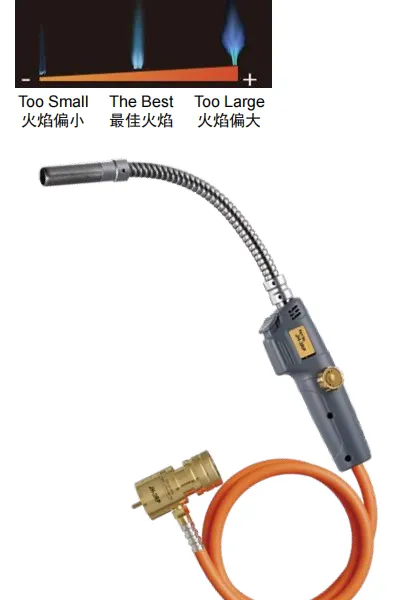
Brazing heat concentration is set at the tip, and the two figures that decide it are the orifice size and the shape of the flame.
A small orifice produces a narrow, intense flame. A larger orifice produces a wider flame with the same total output spread over more area.
The right choice follows the joint. A narrow flame suits a small fitting where a wide flame would spill onto the surrounding pipe.
Flame shape has a second element beyond width. A flame with a short, bright inner cone concentrates its heat in a small volume, which raises the temperature at the work.
The burner ports and the mixing path set that shape, which is why two burners with the same orifice can produce noticeably different flames.
The useful rule for a bench is to choose the smallest tip that will heat the fitting in reasonable time, then hold it steady.
3. Torch Design Innovation: Swirl, Mixing and the Burner Tube
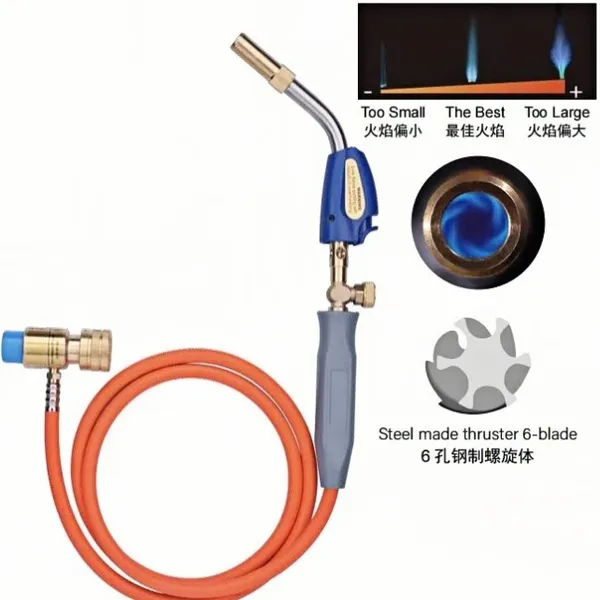
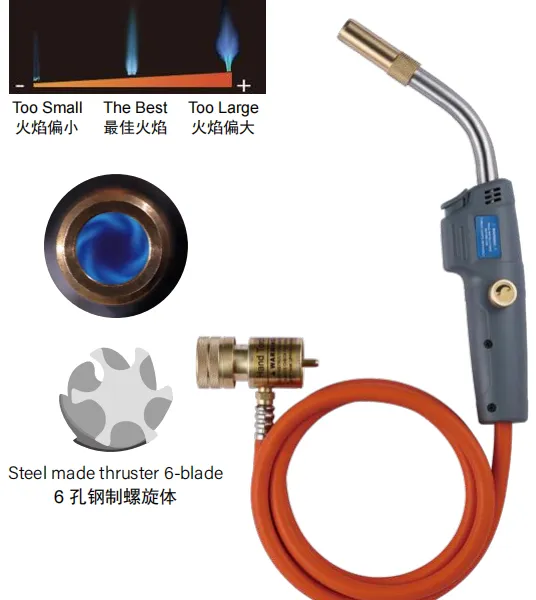
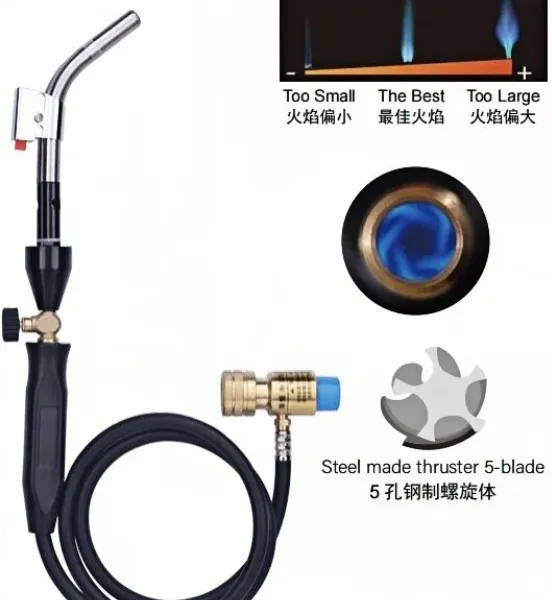
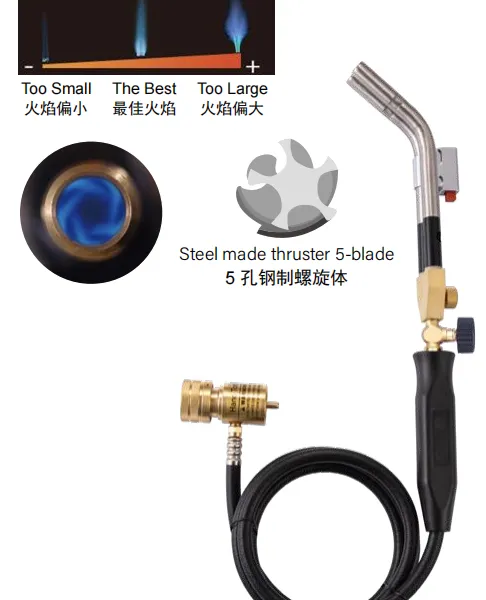
The torch design innovation that matters most on a daily basis is not visible from outside, because it happens inside the burner tube.
A fuel jet delivers gas into a mixing chamber, where it meets the air drawn in through ports in the burner body.
If the two streams do not mix properly, combustion happens late, the flame lengthens and part of the output leaves the work unburnt.
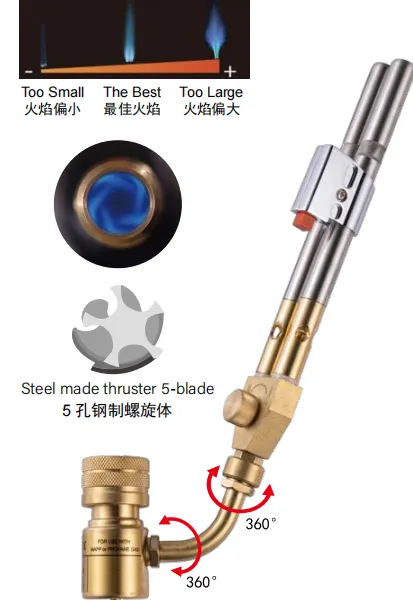
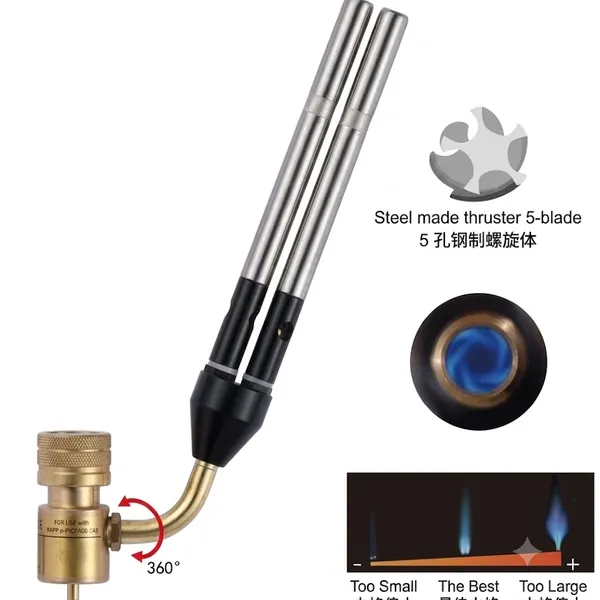
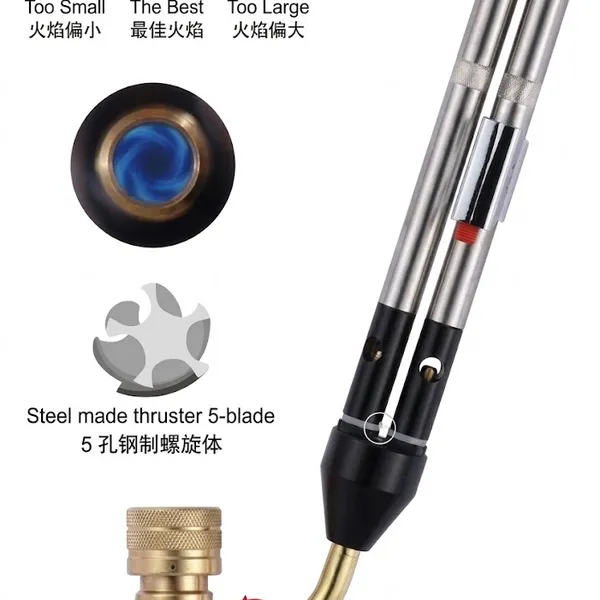
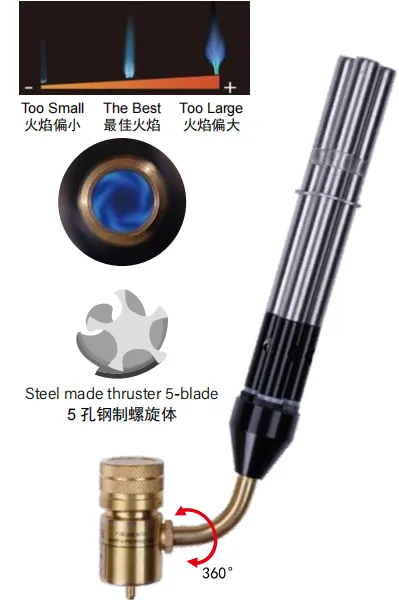
A swirl passage machined into the burner tube turns the mixture as it travels, which brings fuel and air into contact before the tip.
The result is a shorter, hotter flame with a more defined inner cone, and that definition is what a technician aims at the joint.
A worn or partly blocked port undoes that work. Air drawn through a restricted port upsets the ratio the burner was set for, which lengthens the flame and softens the cone at the tip.
Wintooltech machines the burner bodies and the mixing passages on CNC and digital machining equipment, which keeps the jet and the swirl geometry consistent from one unit to the next.
4. Torch Thermal Efficiency Improvement: Reflectors and Heat Shields
A simple torch thermal efficiency improvement is available on any bench, and it costs nothing but a few minutes of setup.
A heat shield placed behind the joint reflects radiated heat back towards the fitting instead of letting it disappear into the wall.
The same shield protects anything behind the work, which is why it belongs in the routine on a pipe running close to timber or cable.
The gain is real but modest. A shield will not double the speed of a joint, though it does reduce the time spent waiting for temperature.
A reflector has limits. In a confined space it can trap heat around the burner and raise the temperature of the head itself.
Where the flame is enclosed, the shield is placed to protect the surroundings rather than to bounce heat back at the fitting.
5. Brazing Heat Concentration: Holding the Cone on the Joint
Brazing heat concentration depends as much on the operator as on the burner, and the controlling habit is where the inner cone sits.
The hottest part of an air fuel flame is the tip of the bright inner cone, just before the outer envelope.
Holding that cone on the joint puts the maximum heat into the fitting. Holding it well away lets the flame spread and cool before it arrives.
A gap of roughly 10 mm to 15 mm between the cone tip and the work is the range most benches settle on.
Steady beats fast. A burner swept around a fitting delivers less heat at any point than the same burner held still for a count.
On a large fitting two burners or a multi tip head are turned slightly towards each other, so the cones meet across the joint rather than on one side.
Angle matters at the tip as well. A cone held square to the pipe puts heat into the fitting, while the same cone held at a shallow angle skims along the surface and leaves the far wall of the fitting cold.
6. Torch Design Innovation: Multi Tip Heads and Heat Spread
A multi tip head is the clearest example of torch design innovation that changes the work rather than the specification sheet.
Two tips on one body deliver heat to two sides of a fitting at once, which removes the need to sweep the burner around the joint.
Three tips spread the heat further and suit a larger fitting where a single cone cannot bring the whole circumference up together.
The design also changes how the head is held. A multi tip head is wider, so it approaches a joint in a confined corner differently from a single tip burner.
Spacing is part of the design. Tips set close together concentrate output, while tips set apart spread it across a wider band of pipe.
The table sets out how the three head types are used on a typical copper range.
| Head | Coverage | Typical use |
|---|---|---|
| Single tip | One cone, narrow band | Branches and tight corners |
| Dual tip | Two cones, opposite sides | 22 mm to 28 mm lines |
| Triple tip | Three cones, wide spread | Large fittings and heavy bodies |
The table also shows why a bench tends to hold more than one head, since the widest spread is awkward work on the smallest fitting.
7. Torch Thermal Efficiency Improvement: Measuring What Changed
A torch thermal efficiency improvement is worth measuring, or the bench is left comparing impressions rather than results.
The simplest measure is the time from ignition to the point at which the filler flows, taken on a joint of a set size.
A second measure is fuel used per joint, which can be followed by weighing the cylinder before and after a known number of joints.
A third is the number of joints completed on one cylinder, which captures both the flame and the technique in a single figure.
The measurements are worth taking before and after a change, with the same operator, the same joint size and the same working position.
A small log of twenty joints tells a bench more about its own efficiency than any catalogue curve, because it reflects the actual plumbing and the actual draughts.
Wentu lists the tip size and the gas together for each burner, so a bench can log its results against a known pairing. Yichun Wentu Imp&Exp Trade Department supplies single, dual and triple tip heads on a shared hose body, which lets a shop compare spreads without changing the rest of the set.
8. Brazing Heat Concentration: Practice Notes for a Busy Bench
Brazing heat concentration is easier to hold when the bench has a routine, and five habits carry most of the gain.
Heat the fitting evenly rather than the pipe. Working around the joint keeps the whole circumference rising together.
Choose the tip from the joint, not from habit. The smallest tip that will heat the fitting in reasonable time keeps the heat where it is wanted.
Clean the tip regularly, since a partly blocked orifice broadens the flame and softens the cone that carries the heat.
Check the jet against the gas. A jet sized for propane will not give the same flame on MAPP, and the mismatch is a quiet drain on efficiency.
A reflector follows its own rule. Placed to protect the surroundings it costs nothing, while a reflector arranged to bounce heat back into a confined space can raise the temperature of the burner head itself.
Yichun Wentu Imp&Exp Trade Department lists the tip size, the gas and the recommended pressure together for each burner, and Wentu keeps single, dual and triple tip heads on a shared hose body so a bench can change the spread without changing the set.
9. Frequently Asked Questions on Torch Thermal Efficiency Improvement
9.1 Where is heat lost in a brazing flame?
Heat leaves a brazing flame in four places, and the two largest on an ordinary bench job are convection and conduction. Air moving across the flame carries heat away, which is why a breeze on outdoor work adds to every joint, while heat travelling down the pipe away from the fitting is lost to the joint even though it is not lost to the physics. Radiation to the surrounding surfaces follows, and incomplete combustion appears when the fuel and air are not mixed properly, showing as a long soft flame that carries unburned fuel past the work.
9.2 How is brazing heat concentration achieved?
Brazing heat concentration is achieved at the tip and at the hand. A small orifice produces a narrow intense flame, while a larger one spreads the same output over more area, so the right choice follows the fitting rather than the catalogue. A short bright inner cone raises the temperature at the work, and the burner ports and mixing path set that shape. Holding the cone roughly 10 mm to 15 mm from the joint puts the maximum heat into the fitting, and a burner held still delivers more than the same burner swept around the pipe.
9.3 What torch design innovation matters most?
The torch design innovation that matters most on a daily basis happens inside the burner tube, where a fuel jet meets the air drawn in through the ports. If the two streams do not mix properly, combustion happens late, the flame lengthens and part of the output leaves the work unburnt. A swirl passage machined into the burner tube turns the mixture as it travels, which brings fuel and air into contact before the tip and produces a shorter, hotter flame with a more defined cone. Multi tip heads change the work as well, spreading heat across two or three sides of a fitting.
9.4 How can a bench measure thermal efficiency?
A bench can measure thermal efficiency with three simple figures, all of which need a baseline taken before anything is changed. The first is the time from ignition to the point at which the filler flows on a joint of a set size, which captures the flame and the technique together. The second is fuel used per joint, followed by weighing the cylinder before and after a known number of joints. The third is the number of joints completed on one cylinder, and a log of twenty joints with the same operator and the same joint size is enough to show whether a change helped.
Recently Posted
-
Factory Testing Before Shipping Torches and Power Tools
October 20, 2026A buyer once received a batch of 600 torches in which 14 units would not hold pressure at the valve stem, a fault that appeared w Read More
-
Writing an RFQ for Hardware Tools and Gas Torches
October 19, 2026An importer sent the same enquiry to three suppliers and received three quotes that could not be compared. One priced a torch hea Read More
-
What Is Hardware in the Tool Trade? A Practical Definition
October 19, 2026A purchasing manager once asked a supplier for all the hardware on a tool order and received three cartons of screws with no dril Read More
-
Gas Torches in Jewelry Making and Precision Metalwork
October 16, 2026A repair bench once lost a ring setting to a flame that was too large rather than too hot. The torch was a workshop unit meant fo Read More

Contact Us
Recommended Products
-
 WT‑ST Heavy‑Duty Brass Valve MAPP/Propane Torch Adjustable Flame Gas Soldering TorchNegotiableMOQ: 100 Pieces
-
WT‑SSP Patented Self‑Igniting MAPP Gas Torch Stainless Steel Tip Heat‑Concentrating TorchNegotiableMOQ: 100 Pieces
-
WT‑SSA‑1 Heavy‑Duty Self‑Igniting MAPP Torch Aluminum Housing 360° Swivel Brazing TorchNegotiableMOQ: 100 Pieces
-
WT‑D1 Dual‑Tip High‑Heat MAPP Gas Torch 360° Swivel Twin Flame Copper Pipe Brazing TorchNegotiableMOQ: 100 Pieces
-
WT‑D2 Twin Flame MAPP Gas Torch 360° Two‑Way Swivel Dual Tip High‑Efficiency TorchNegotiableMOQ: 100 Pieces
-
WT‑D2SA Self‑Igniting Dual‑Tip MAPP Torch 360° Two‑Way Swivel Aluminum Igniter TorchNegotiableMOQ: 100 Pieces
-
WT‑D2P Patented Switchable Single/Dual Tip MAPP Torch 360° Two‑Way Swivel Brazing TorchNegotiableMOQ: 100 Pieces
-
WT‑D2AP Patented Switchable Dual‑Tip Self‑Igniting MAPP Torch Aluminum Housing TorchNegotiableMOQ: 100 Pieces
-
WT‑D1A Self‑Igniting Dual‑Tip MAPP Gas Torch 360° Swivel Twin Burner Pipe Welding TorchNegotiableMOQ: 100 Pieces
-
WT‑D1SA Premium Self‑Igniting Dual‑Tip MAPP Torch Aluminum Igniter Twin Flame TorchNegotiableMOQ: 100 Pieces
-
WT‑T Triple‑Tip Ultra High‑Output MAPP Gas Torch 360° Swivel Three‑Flame Brazing TorchNegotiableMOQ: 100 Pieces
-
WT‑TSA Self‑Igniting Triple‑Tip MAPP Gas Torch Aluminum Housing High‑Heat Brazing TorchNegotiableMOQ: 100 Pieces
-
WH‑SS Self‑Igniting MAPP Gas Hose Torch Flexible High‑Pressure Extension Soldering TorchNegotiableMOQ: 100 Pieces
-
WH‑SST Self‑Igniting Brass Tip MAPP Hose Torch Fast‑Cooling Extension Brazing TorchNegotiableMOQ: 100 Pieces
-
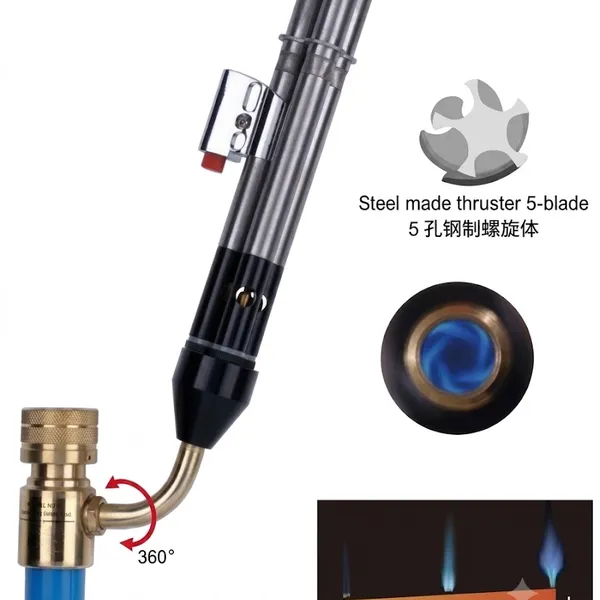
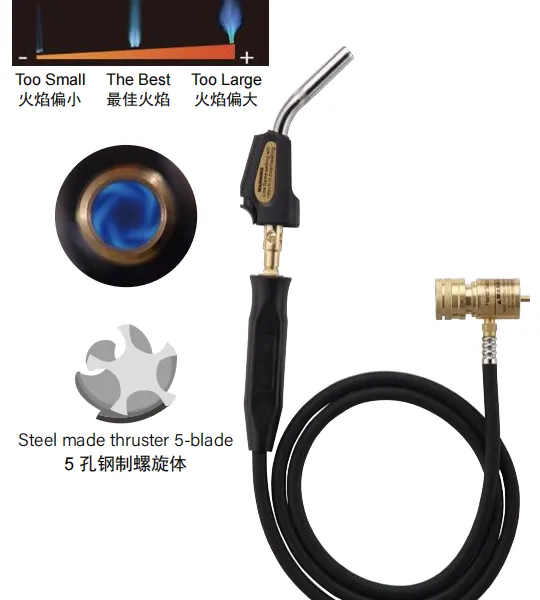
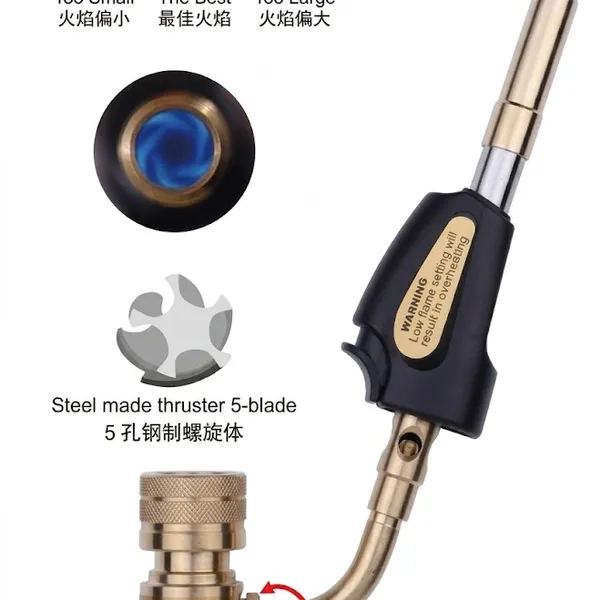
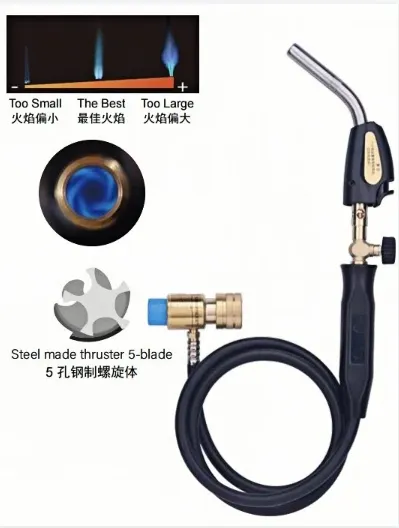
WH‑SSV MAPP Hose Torch With Needle‑Valve Flame Adjustment Self‑Igniting Extension TorchNegotiableMOQ: 100 Pieces
-
WH‑SSVT Deluxe MAPP Hose Torch With Needle‑Valve & Thick Brass Tip 6‑Blade Thruster TorchNegotiableMOQ: 100 Pieces
-
WH‑SSVTP Patented One‑Piece MAPP Hose Torch One‑Hand Needle‑Valve & Thick Brass TipNegotiableMOQ: 100 Pieces
-
WH‑DSVA Dual‑Tip MAPP Hose Torch With Needle Valve Self‑Igniting Aluminum Igniter TorchNegotiableMOQ: 100 Pieces
-
WH‑DSVAP Patented Switchable Dual‑Tip MAPP Hose Torch Needle‑Valve & Aluminum‑Body TorchNegotiableMOQ: 100 Pieces
-
WH‑SSVNP Patented Flexible Stainless Tube MAPP Hose Torch All‑Directional Gooseneck TorchNegotiableMOQ: 100 Pieces