
 Business License
Blog Categories

Drone Solutions for Night Lighting and Event Support
A festival organiser needed a walkway lit from above rather than from towers, and the tower crew quoted three days of setup for one night of use. The alternative was a craft carrying a lamp array and holding position over the ground it had to light.
This article sets out what a drone lighting solution has to deliver on site, how uav night event support is powered across a full programme, and how tethered drone illumination is laid out when the craft has to stay up for hours rather than minutes. A site case and the most common buyer questions follow.
1. Drone Lighting Solution: What the Job Requires
A drone lighting solution answers a requirement that towers answer badly, because the light has to sit above the crowd rather than beside it on a mast that takes days to raise.
Illumination from above suits a defined working area. A craft at 20 m to 30 m can cover a stage apron, a car park or a marshalling lane without the long shadows a side mounted floodlight throws.
The lamp array rather than the airframe sets the load. A 400 W to 1,200 W LED array is typical for event work, and that figure drives the station rating more than the craft mass does.
Colour temperature also enters the brief. A 5,000 K array renders a scene close to daylight, while a 3,000 K array reads warmer and is often chosen for hospitality areas and food courts.
Wintooltech treats lighting as a power problem first, because a lamp that dims as the bus voltage sags is a lamp that fails the brief it was bought for.
2. UAV Night Event Support: Power and Payload
UAV night event support is sized around the hours the craft has to stay up, and a programme that runs from dusk to the end of a headline set is a four to six hour duty.
The table sets out the loads a night lighting craft carries and how each one behaves across a shift.
| Load | Typical draw | Behaviour across a shift |
|---|---|---|
| Lamp array | 0.4 to 1.2 kW | Steady, dimmed in steps |
| Hover and position holding | 2.2 to 3.8 kW | Steady, rises in gusts |
| Control, gimbal and telemetry | 0.06 to 0.14 kW | Constant and small |
| Gust margin | 35 to 50 percent | Intermittent |
Those figures point to a 5 kW unit for a duty that averages about 3 kW once the lamp is dimmed to two thirds for most of a night.
A lamp array is dimmed rather than switched. Dimming cuts the draw in steps, so the station sees a series of small changes rather than one large step at the start of the set.
Payload mass decides the craft class. A 1,200 W array with its driver and heat sink may weigh 3 kg to 6 kg, which pushes the frame into the heavy lift class used for lifting work rather than survey work.
Yichun Wentu offers a power head and a tether as a matched set, so a builder does not have to prove that a station and a cable from two sources work together.
3. Tethered Drone Illumination System Layout
Tethered drone illumination is laid out around three lines, carrying power, control and a safety return, and the ground end has to manage all three at once.
The power line is the heaviest of the three and the one that sets the cable rating. A 120 m tether for a 5 kW craft weighs 5 kg to 9 kg depending on conductor gauge and sheath.
A powered winch with a tensioner and a guide keeps the line orderly. A tether pulled off the drum by hand forms loops, and a loop caught by a rotor can stop a show without warning.
The lamp array needs a cooling path as well as a power path. Forced air over a finned driver keeps the junction temperature inside its rating across a four hour run.
The ground station usually sits on a vehicle or a skid so it can be repositioned between events, and a unit that has to be craned into place defeats the point of a mobile platform.
The control line carries the gimbal command and the telemetry, and it has to keep working while the lamp draws a pulse. A shielded pair with a separate return keeps the command path clean, so a dimming step does not show up as a flicker on the ground.
The control line carries the gimbal command and the telemetry, and it has to keep working while the lamp draws a pulse. A shielded pair with a separate return keeps the command path clean, so a dimming step does not show up as a flicker on the ground.
4. Drone Lighting Solution and Lumen Planning
A drone lighting solution is judged by the light delivered to the ground, so the planning figure is illuminance at the working surface rather than the lumen figure on the lamp label.
A lamp rated at 100,000 lm at 25 m produces roughly 60 lx to 90 lx across its beam footprint, depending on beam angle and lens losses.
Beam angle decides the trade off. A 40 degree beam concentrates light into a bright pool, while a 90 degree beam spreads a lower level across a wider area.
Safety lighting for a walkway needs far less than a broadcast fill. A walkway may need 20 lx, while a stage apron for filming may need 300 lx or more.
Two craft can be stacked over one area to raise the level without lifting either one higher, and that overlap is planned from the beam figures rather than left to chance.
Wind changes what the light delivers on the ground as well, since the craft moves to hold station and the beam tilts with it. A wider beam tolerates that movement better than a narrow one, which is why a 90 degree unit is often chosen for a walkway.
Wind changes what the light delivers on the ground as well, since the craft moves to hold station and the beam tilts with it. A wider beam tolerates that movement better than a narrow one, which is why a 90 degree unit is often chosen for a walkway.
5. UAV Night Event Support Through a Full Programme
UAV night event support has to survive a programme that changes shape, because a set that runs long or a schedule that slips pushes the craft past its planned duty.
Continuous tethered power removes the swap a battery craft needs every twenty minutes, and that swap would otherwise cost ten minutes and a second airframe on the ground.
The station should be sized for the longest duty in the programme rather than the average. A four hour average becomes a six hour peak when an encore is added at short notice.
Wind also moves the power figure, since a gust pushes the hover load up. A station with a working margin holds the beam steady through a squall, while a tight unit lets the beam drift.
A changeover to a second craft takes about three minutes when the station is common to both, and far longer when the tether and the connector have to be swapped as well.
A programme with a break in it also suits a tethered craft, since the station can stay in place while the crew rests. The craft can come down and go back up without a fresh pack or a second ground unit.
A programme with a break in it also suits a tethered craft, since the station can stay in place while the crew rests. The craft can come down and go back up without a fresh pack or a second ground unit.
Wentu suggests that organisers record the duty, the wind limit and the changeover plan on the site sheet before a season begins.
6. Tethered Drone Illumination Safety and Wind Limits
Three limits belong on paper before a night flight: a wind ceiling, a maximum line tension and a closed ground area.
Wind halts a show first. A craft that holds its mark at 8 m per second may lose the line at 12, and the beam wanders well before that figure is reached.
A ground area has to be closed beneath the working position, because anything released falls almost straight down onto the surface below rather than drifting sideways.
A dropped link must leave the craft on a slow descent rather than a fall. A small reserve supply for that descent turns a fault into a short interruption instead of an accident.
A crew list belongs in the same plan. A lighting craft needs a pilot, a spotter and an operator at the generator end while the public stays outside the closed line.
Yichun Wentu Imp&Exp Trade Department prefers to see a wind figure and a closed area printed on the site sheet, because a number that never reaches the site is a number that gets ignored.
7. Drone Lighting Solution in Cold and Damp Conditions
A drone lighting solution meets its hardest conditions on a damp autumn night, when condensation forms on a lamp driver and cable sheathing stiffens in the cold.
Water ingress is the main risk. A driver housing with a gasket and a drain path keeps moisture from pooling on the board and shorting a track.
A lamp lens collects a film of dew faster than the housing does, and the visible output can fall by 10 percent or more behind it. A wipe before the flight or a small lens heater clears the film.
A cold drum stiffens the sheath, so the cable will not pay out evenly from the winch. Letting the drum sit in a warm van for an hour before a shift softens it.
A short purge of the ground connector before each shift clears any film of moisture and gives the crew a chance to inspect the first 10 m of cable for wear.
Dew forms on the lamp lens as well as on the driver. A lens heater or a simple wipe before the shift clears a film that can cut the visible output by 10 percent or more.
8. A Site Case: Tethered Drone Illumination at a Festival Ground
An event team trialled a tethered lighting craft over the walkway between a stage and a food court across a three night festival.
The rig was a 5 kW Wentu station, a 100 m tether and a 900 W LED array on a heavy lift platform. The array was dimmed to about two thirds after the headline set each night.
The full array pass drew about 4.1 kW, falling to about 3.3 kW once dimmed. The station held the bus voltage steady through two gusty periods on the second night.
Two changes came out of the trial. A guide roller was added where the line crossed a barrier rail, and a drip shield was fitted over the lamp driver after light rain on the opening night.
The team kept a tower over the main stage and used the craft on the walkway alone, where the long shadows of a mast had been the complaint from the start.
9. Frequently Asked Questions on Drone Lighting Solution
9.1 What does a drone lighting solution need to deliver?
A drone lighting solution has to deliver light where the people stand rather than where a mast can be raised, so the planning figure is illuminance at the working surface. A 400 W to 1,200 W LED array is typical for event work, and the array rather than the airframe sets the station rating. A craft at 20 m to 30 m covers a stage apron or a car park without the long shadows a side mounted floodlight throws. The same unit loses light with distance, so a height of 25 m and a height of 40 m give quite different results on the ground.
9.2 How long can uav night event support run on tethered power?
UAV night event support runs for as long as the ground station is supplied, so the practical limit is the duty in the programme rather than the energy in a pack. A programme from dusk to the end of a headline set is a four to six hour duty, and the station should be sized for the longest duty rather than the average, since an encore can add hours at short notice. Continuous power also removes the swap a battery craft needs every twenty minutes, which otherwise costs ten minutes each time.
9.3 How is a tethered drone illumination system laid out?
A tethered drone illumination system is laid out around three lines carrying power, control and a safety return, with the ground end managing all three at once. The power line is the heaviest and sets the cable rating, since a 120 m tether for a 5 kW craft weighs 5 kg to 9 kg depending on conductor gauge and sheath. A winch with a tensioner and a guide keeps the cable from looping, because a loop drawn into a rotor can end a show early. The ground station normally sits on a vehicle or a skid so it can be moved between events.
9.4 What are the safety limits for tethered night lighting?
Night lighting needs three limits on paper before the first flight: a wind ceiling, a maximum line tension and a closed ground area. Wind halts a show first, and the beam wanders long before the craft loses its mark. The closed area sits beneath the working position rather than around the operator, so the public stays clear of the flight path. Yichun Wentu suggests keeping a small reserve supply for a slow descent, which turns a fault into a short interruption instead of an accident.
Recently Posted
-
Gas Torches in Jewelry Making and Precision Metalwork
October 16, 2026A repair bench once lost a ring setting to a flame that was too large rather than too hot. The torch was a workshop unit meant fo Read More
 -
Flame Temperature and Gas Pressure Specifications for Torches
October 16, 2026Two torches with the same headline flame temperature can behave quite differently on the bench, because the second figure on the Read More
 -
Self Igniting vs Manual Ignition Gas Torches
October 16, 2026A technician on a roof replaced a torch mid job and noticed that the two models weighed the same and lit the same flame, yet one Read More
 -
Introduction to Air Fuel Torches: MAPP, Propane and LPG
October 15, 2026A workshop bought a torch for brazing refrigeration lines and found the flame too soft to bring a joint up to temperature. The to Read More

Contact Us
Recommended Products
-
 WT‑SSA Premium Aluminum Housing Self‑Igniting MAPP Torch, 360° Swivel Stainless Tip TorchNegotiableMOQ: 100 Pieces
 -
WT‑SST Self‑Igniting Brass Tip MAPP Torch, 360° Swivel Fast‑Cooling Premium Brazing TorchNegotiableMOQ: 100 Pieces
-
WT‑SS Self‑Igniting MAPP Gas Torch, 360° Swivel Stainless Steel Tip High‑Heat Brazing BlowtorchNegotiableMOQ: 100 Pieces
-
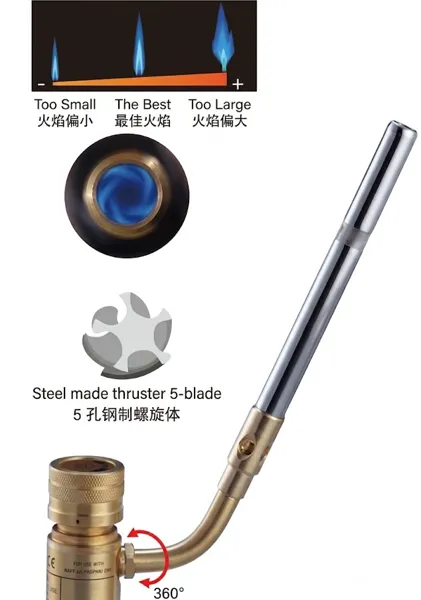
WT‑S 360° Swivel Single‑Tip MAPP/Propane Gas Torch, Stainless Steel Tip Manual Ignition Brazing TorchNegotiableMOQ: 100 Pieces
-
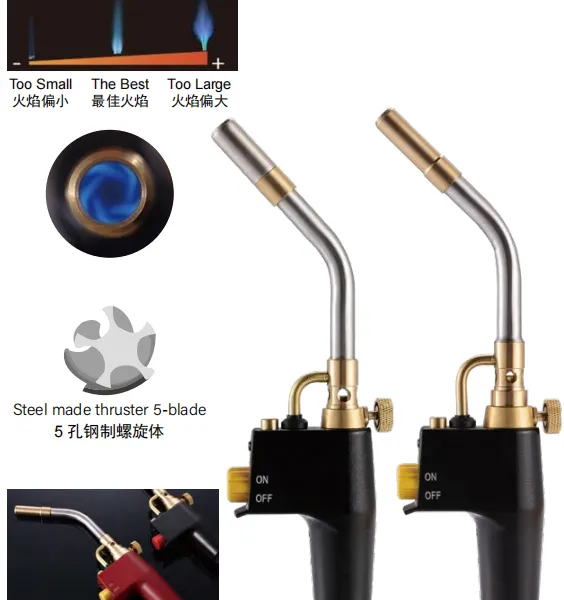
WT‑5STA Premium Aluminum‑Handle Pistol‑Grip MAPP Torch Heavy‑Duty Brass‑Tip Welding TorchNegotiableMOQ: 100 Pieces
-
WT‑5ST Pistol‑Grip MAPP Gas Torch With Fast‑Cooling Brass Tip Safety‑Lock TorchNegotiableMOQ: 100 Pieces
-
WT‑5S Ergonomic Pistol‑Grip MAPP Gas Torch Instant‑Ignition Safety‑Lock Brazing TorchNegotiableMOQ: 100 Pieces
-
WH‑DSVP Patented Switchable Dual‑Tip MAPP Hose Torch One‑Hand Needle‑Valve TorchNegotiableMOQ: 100 Pieces
-
WH‑SSVNP Patented Flexible Stainless Tube MAPP Hose Torch All‑Directional Gooseneck TorchNegotiableMOQ: 100 Pieces
-
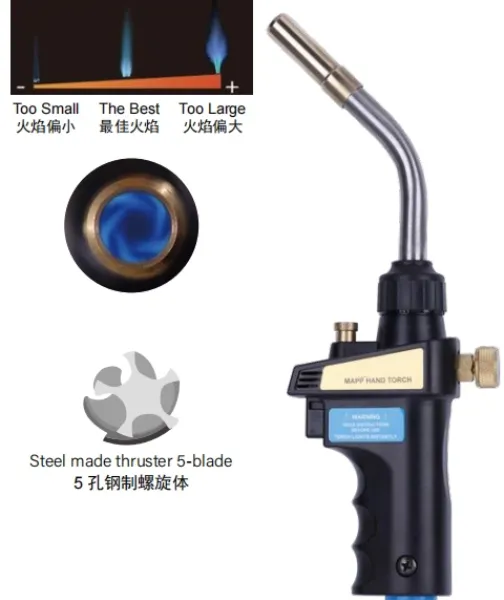
WH‑DSVAP Patented Switchable Dual‑Tip MAPP Hose Torch Needle‑Valve & Aluminum‑Body TorchNegotiableMOQ: 100 Pieces
-
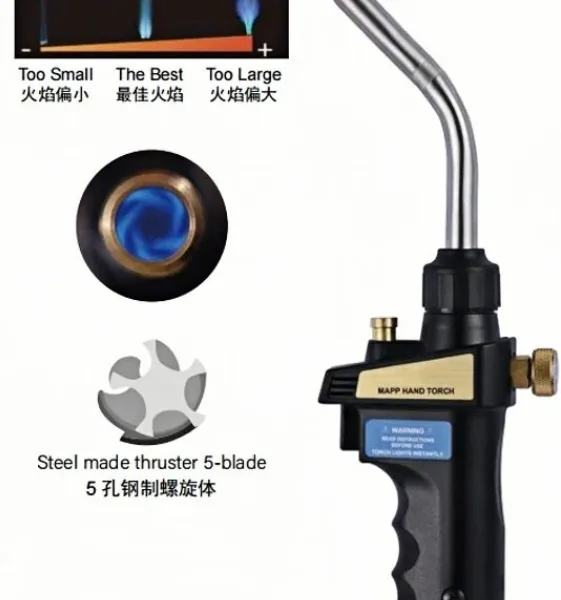
WH‑DSVA Dual‑Tip MAPP Hose Torch With Needle Valve Self‑Igniting Aluminum Igniter TorchNegotiableMOQ: 100 Pieces
-
WH‑SSVTP Patented One‑Piece MAPP Hose Torch One‑Hand Needle‑Valve & Thick Brass TipNegotiableMOQ: 100 Pieces
-
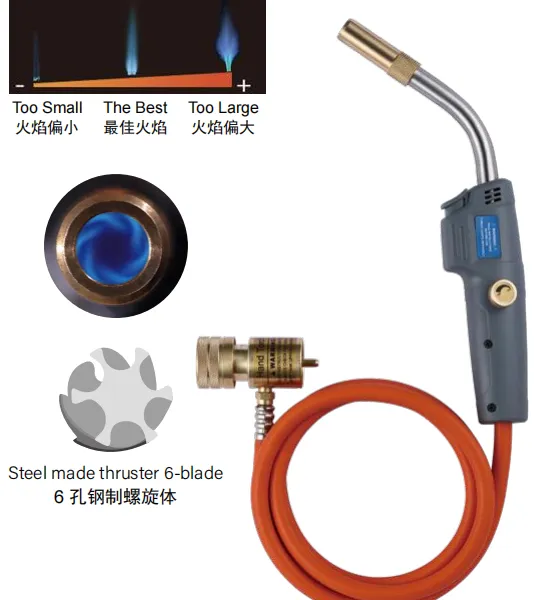
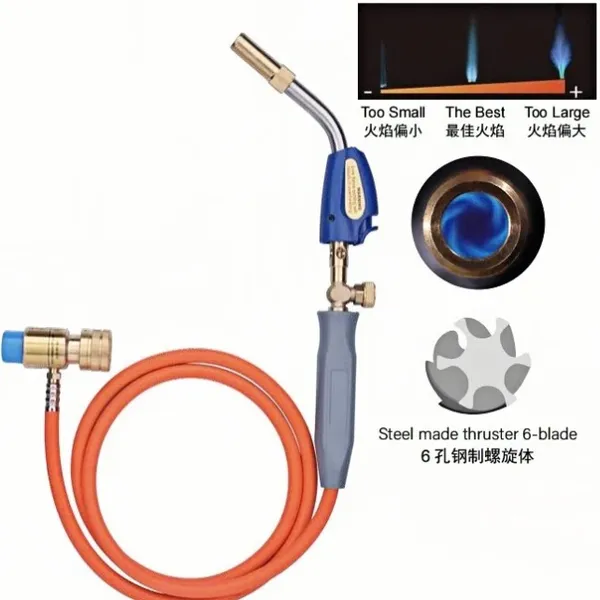
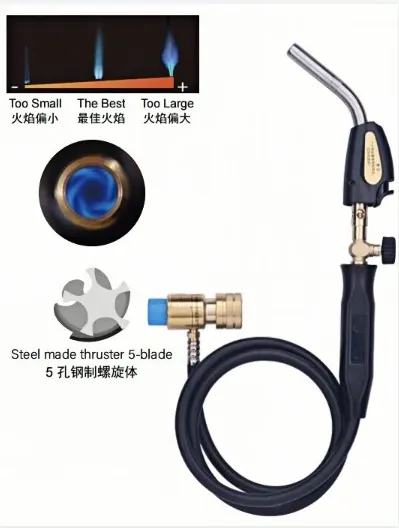
WH‑SSVT Deluxe MAPP Hose Torch With Needle‑Valve & Thick Brass Tip 6‑Blade Thruster TorchNegotiableMOQ: 100 Pieces
-
WH‑SSV MAPP Hose Torch With Needle‑Valve Flame Adjustment Self‑Igniting Extension TorchNegotiableMOQ: 100 Pieces
-
WH‑SST Self‑Igniting Brass Tip MAPP Hose Torch Fast‑Cooling Extension Brazing TorchNegotiableMOQ: 100 Pieces
-
WH‑SS Self‑Igniting MAPP Gas Hose Torch Flexible High‑Pressure Extension Soldering TorchNegotiableMOQ: 100 Pieces
-
WT‑TSA Self‑Igniting Triple‑Tip MAPP Gas Torch Aluminum Housing High‑Heat Brazing TorchNegotiableMOQ: 100 Pieces
-
WT‑T Triple‑Tip Ultra High‑Output MAPP Gas Torch 360° Swivel Three‑Flame Brazing TorchNegotiableMOQ: 100 Pieces
-
WT‑D1SA Premium Self‑Igniting Dual‑Tip MAPP Torch Aluminum Igniter Twin Flame TorchNegotiableMOQ: 100 Pieces
-
WT‑D1A Self‑Igniting Dual‑Tip MAPP Gas Torch 360° Swivel Twin Burner Pipe Welding TorchNegotiableMOQ: 100 Pieces